Fatih
O mais autêntico e acessível de Istambul
Pontuações
Fatih is the Istanbul that many tourists never see, and that's precisely why it deserves a visit. This extensive district, covering much of the historic peninsula west of Sultanahmet, is the city's conservative heart — a place where traditional Ottoman life persists in ways that have disappeared from more touristy neighborhoods. You won't find cocktail bars or fusion restaurants here, but you'll discover raw, fascinating authenticity, incredibly affordable prices, and some of Istanbul's most impressive yet least-visited historical treasures.
The Fatih Mosque (Fatih Camii), which gives the district its name, was built by Sultan Mehmed II "the Conqueror" in 1463, just ten years after conquering Constantinople. It was Istanbul's first imperial mosque, erected on the ruins of the Church of the Holy Apostles — Byzantium's second most important church after Hagia Sophia. The current mosque is an 18th-century reconstruction after an earthquake, but its complex — including madrasas, a hospital, a hammam, a caravanserai, and Mehmed II's tomb — conveys the monumental scale of Ottoman pious foundations.
Fener and Balat are undoubtedly Istanbul's most photogenic neighborhoods. These former Greek and Jewish communities along the Golden Horn have become trendy destinations thanks to their colorful houses — facades painted in yellow, pink, blue, and green lining steep, winding streets. But beyond the photogenic surface, they tell a moving story of diversity and coexistence in Ottoman Istanbul.
The Ecumenical Orthodox Patriarchate in Fener has been the spiritual seat of the worldwide Orthodox Church since 1601. The Bulgarian Iron Church (Demir Kilise) in Balat, entirely built from cast iron prefabricated in Vienna in 1898, is a neo-Gothic structure of gleaming golden metal that seems from a fairy tale.
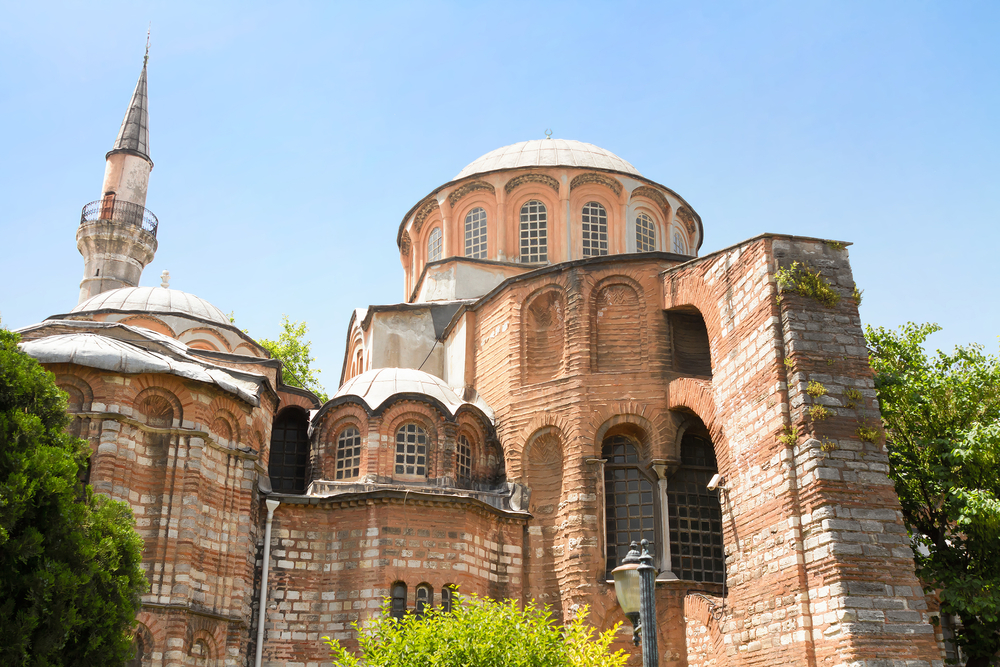
The Chora Church (Kariye Camii) in Edirnekapi is without exaggeration one of the world's most important artistic treasures. This small Byzantine temple contains the best-preserved Byzantine mosaics and frescoes in existence — superior even to those of Ravenna or Sicily. The Last Judgment scenes in the parekklesion, with Christ Anastasis rescuing Adam and Eve from hell, are breathtaking medieval masterpieces.
The Theodosian Walls, built in the 5th century, extend over six kilometers from the Sea of Marmara to the Golden Horn. They were the medieval world's most formidable defense, protecting Constantinople for over a thousand years until the 1453 Ottoman conquest. Walking alongside these monumental towers and gates is a time-travel experience few tourists undertake. The Valens Aqueduct, built in the 4th century, is another impressive monument — its two-level arches crossing Ataturk Boulevard create a surreal blend of ancient Rome and modern Istanbul.
Fatih's gastronomy is authentically local and astonishingly affordable. Vefa Bozacisi (founded 1876) sells boza, a fermented millet drink that's been part of Turkish culture for centuries. Siirt Seref Buryan serves lamb slow-roasted in an underground pit. The Wednesday market (Carsamba Pazari) is one of Istanbul's largest street markets — intense and authentic, not designed for tourists.
Being honest about Fatih: it's a conservative neighborhood with different social norms. Alcohol consumption is very limited, dress tends to be more covered, and Western visitors should respect local customs. That said, Turkish hospitality here is genuine. Safety-wise, Fatih is generally safe by day, though some areas near the walls can be less welcoming at night. Transport includes the M1 metro and proximity to the T1 tram at Aksaray.
The Zeyrek neighborhood, between the Valens Aqueduct and the Golden Horn, harbors another little-known Byzantine treasure: the Zeyrek Mosque (Zeyrek Camii), originally the 12th-century Monastery of the Pantocrator. This complex of three joined churches is the second-largest Byzantine religious building in Istanbul after Hagia Sophia. The surrounding maze of streets with wooden Ottoman houses in various states of preservation gives the area an irresistibly melancholic beauty.
For street food lovers, Fatih is paradise. Simit carts are on every corner for half a euro. Lahmacun stalls serve paper-thin flatbread with spiced minced meat for under two euros. Tandir ovens produce crispy, hot flatbread eaten with cheese, olives, and tea. Near the Fatih Mosque, southeastern Turkish restaurants serve dishes virtually impossible to find in tourist neighborhoods: urfa kebabi, cig kofte (raw bulgur balls with spices), and kunefe (melted cheese between crispy kadayif layers, drenched in syrup).
The Edirnekapi area, where the Chora Church is located, is also where the Theodosian Walls are best appreciated. You can walk along the walls southward, passing medieval towers, monumental gates (including the Gate of Adrianople, through which Mehmed II entered in 1453), and stretches where walls are impressively preserved. In spring, community gardens at the foot of the walls bloom with vegetables and flowers planted by local residents — a striking contrast between monumental history and everyday life.
Accommodation in Fatih is the most affordable in Istanbul's tourist zone. Small family hotels offer clean, functional rooms from EUR 40 per night, often with Turkish breakfast included. Some have begun restoring Ottoman houses in Fener and Balat, creating a nascent boutique hotel sector with character at prices far more reasonable than equivalents in Sultanahmet or Karakoy.
Fatih is for travelers who want to go beyond Istanbul's tourist surface and immerse themselves in the real life of a centuries-old cultural melting pot. Its unbeatable prices, little-visited artistic treasures, and unfiltered everyday authenticity make it an experience that perfectly complements visits to better-known neighborhoods. Fatih isn't for every traveler, but for those who venture to explore it, the reward is a deeper, more honest understanding of what Istanbul truly is.
Walking Fener's streets at dawn, when colorful houses light up with the day's first rays and neighbors begin opening their shops, is one of Istanbul's most poetic experiences. The Greek Orthodox College (Fener Rum Lisesi), an imposing red brick building atop Fener's hill known as "the red school," dominates the neighborhood skyline — a visible reminder of the Greek community that inhabited these streets for centuries. Still functioning with a reduced student body, the building remains one of Fener's most photographed landmarks.
For travelers interested in Ottoman Empire history beyond palaces and mosques, the Fatih Mosque complex offers a unique window into the pious foundation (vakif) system that sustained Ottoman society. Around the mosque you'll find remnants of madrasas (Quranic schools), the caravanserai (travelers' lodge), the public kitchen that fed the poor, and the hammam serving the neighborhood. This city-within-a-city model, where a single complex provided education, lodging, food, hygiene, and spirituality, is the essence of Ottoman urban planning.
The Wednesday market experience alone is worth a trip to Fatih. Arriving early morning, you'll find a labyrinth spanning several streets with vendors selling everything from fresh produce at the season's lowest prices to household goods, clothing, and kitchen utensils. The atmosphere is intensely local — women in headscarves expertly squeeze tomatoes for ripeness, elderly men haggle over the price of walnuts, and children run between stalls eating cotton candy. It's the anti-Grand Bazaar: no tourists, no English signs, no polished presentations — just raw, authentic market culture that has barely changed in centuries.
A detail many travelers don't know: Fatih houses one of Istanbul's most diverse international student communities. Students from Muslim countries in Africa, Central Asia, and the Middle East attend the district's madrasas and universities, adding an unexpectedly multicultural dimension. Near the Fatih Mosque, you'll hear conversations in Arabic, Urdu, Swahili, and Uzbek, and restaurants offer cuisines from these countries alongside Turkish. This diversity within Muslim tradition is fascinating and reflects Istanbul's historic role as the Islamic world's center.
The Golden Horn waterfront along Fatih's northern edge is undergoing a quiet transformation. Former industrial sites are being converted into parks and cultural spaces, and a waterfront walking path now extends from Balat toward Eminonu. This path offers views across the Golden Horn to Karakoy and Galata, and passes through areas where you can watch fishermen casting lines while the minarets of Fatih's mosques rise behind you — a scene that captures the neighborhood's essential character of tradition existing alongside gentle change.
For travelers who have already visited Istanbul's major monuments and are returning for a deeper experience, Fatih offers the most rewarding second-visit itinerary in the city. The combination of the Chora Church's magnificent mosaics, Fener and Balat's photogenic streets and multicultural heritage, the Theodosian Walls' monumental atmosphere, and the genuine conservative neighborhood life creates an experience that is simultaneously more challenging and more rewarding than the standard tourist circuit.
The Golden Horn waterfront along Fatih's northern edge is quietly transforming. Former industrial sites are becoming parks and cultural spaces, and a walking path now extends from Balat toward Eminonu. This path offers views across the Golden Horn to Karakoy and Galata, passing areas where fishermen cast lines while Fatih's mosque minarets rise behind — a scene capturing the neighborhood's essential character of tradition alongside gentle change.
Destaques
Onde comer
O que ver e fazer
Como chegar
Hotéis em Fatih
Encontre os melhores hotéis em Fatih com o melhor preço garantido.
Ver hotéis em Fatih